First 72 Hours

by Rachel Yumin Gwak
A branching simulation where new dog adopters rehearse the hardest decisions of the first three days, and get them wrong somewhere safe before the dog is actually home.
Flagship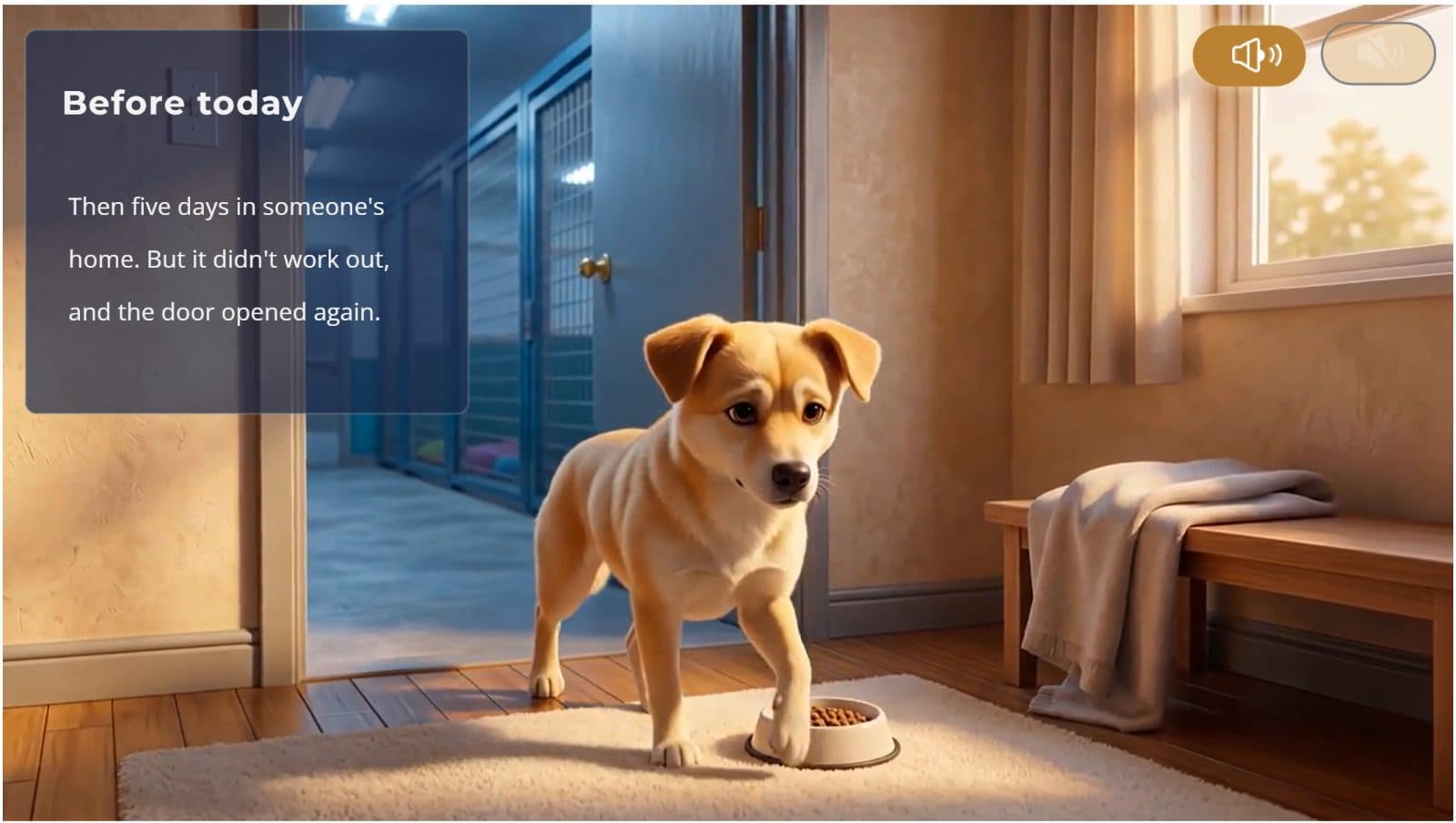
Rachel Yumin Gwak came to this project by way of a humane society volunteer shift and a problem she could not stop thinking about. Most of the dogs being returned were not difficult dogs. They were dogs whose first days were misread by someone who cared a great deal and had never done this before.
Her flagship project, First 72 Hours, walks a new adopter through those first three days with Noori, a dog who has just come home. Rescues already send adopters home with good written guidance. The gap is that it gets read calmly in daylight, then has to be recalled at 2 a.m. by someone exhausted and scared. First 72 Hours is the place to practice those decisions before they cost anything.
Every Wrong Answer Is a Kind One
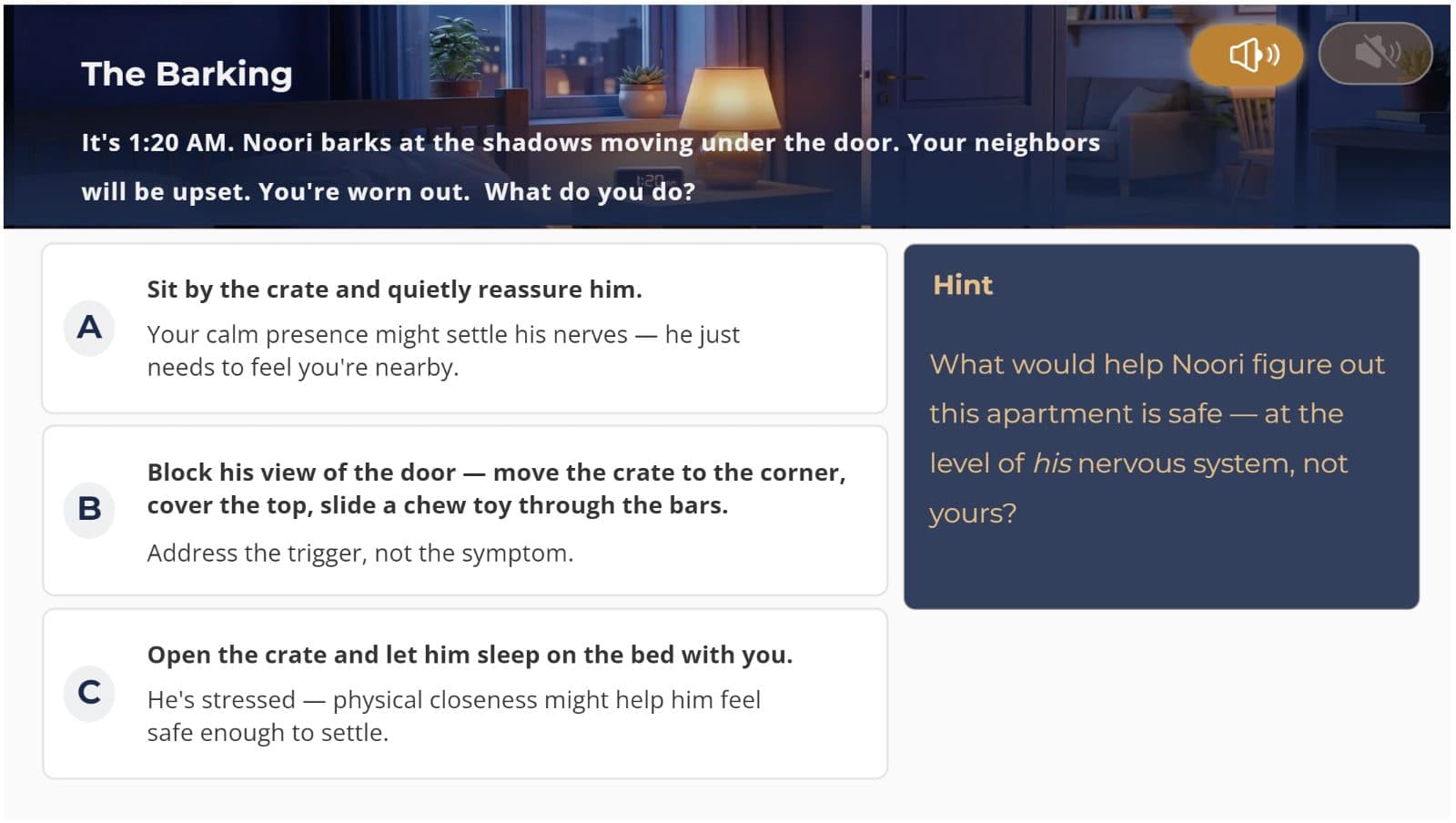
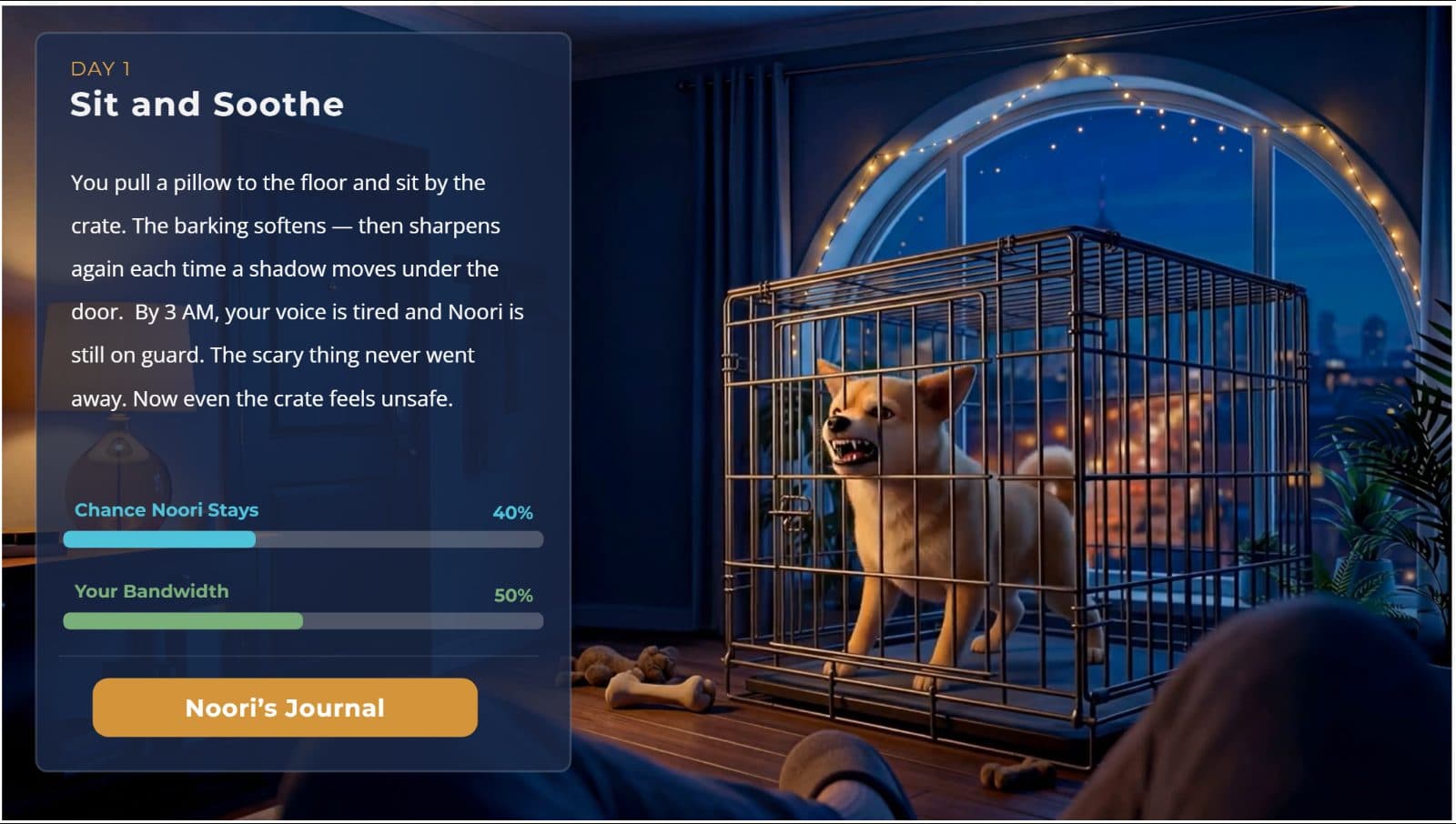
The learner moves through the first three days as a series of decision points. Every choice moves two visible meters: Noori's chance of staying, and the learner's own bandwidth. The consequence plays out before anything is scored. A poor choice is not marked wrong and skipped past. It lands on the dog, and then the learner tries again.
None of the wrong answers are careless or cruel. They are all things a caring, anxious adopter would plausibly do: reach under the bed to comfort a hiding dog, take a new dog to the dog park, correct the growl. The mistakes come from good intentions, which is exactly what makes them worth rehearsing.
Partway through, the simulation opens into a live spoken call with an AI counselor. It is not a quiz about asking for help. The learner has the conversation out loud and is scored on whether they brought specifics or generalities.
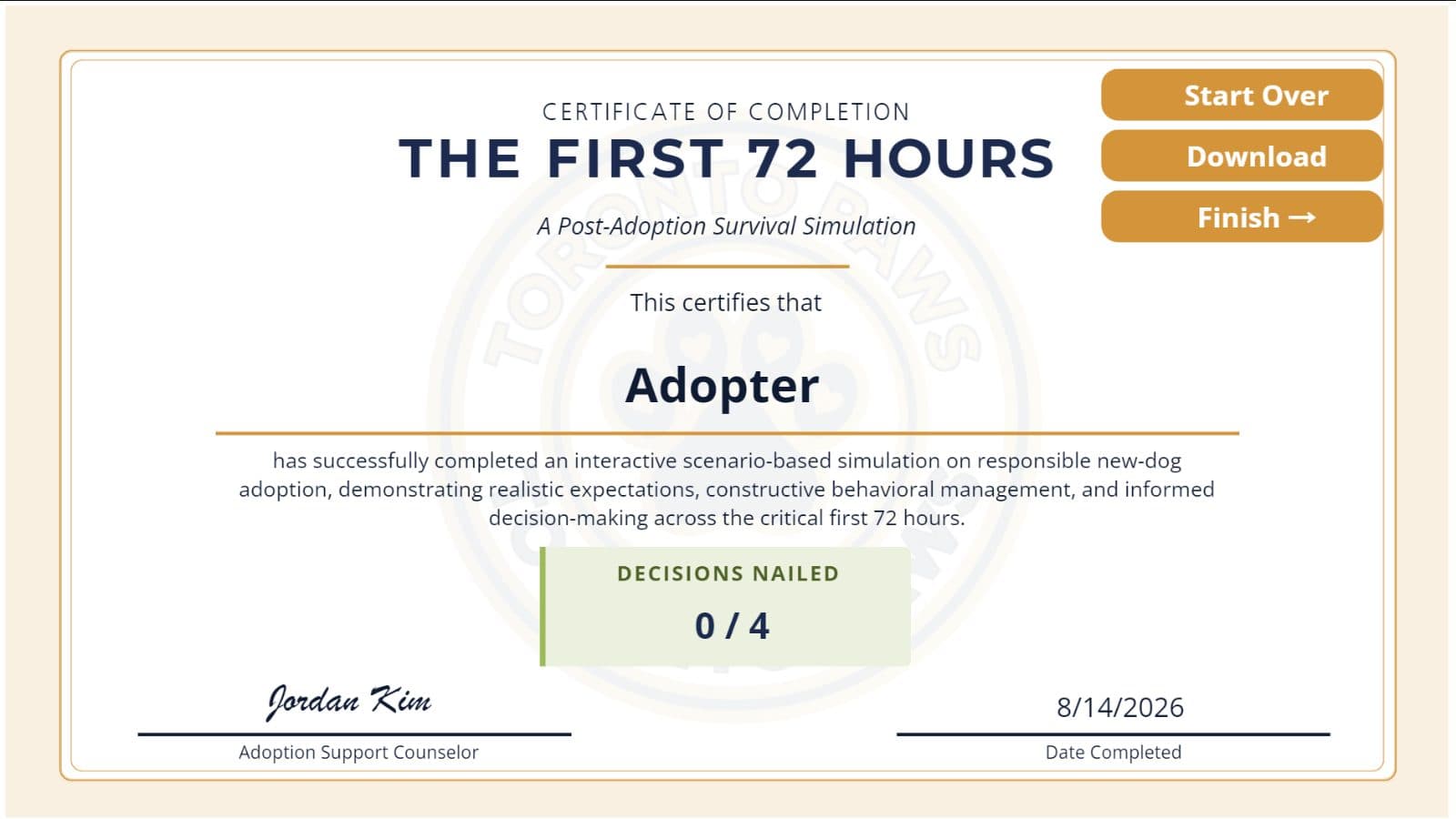
The AI runs inside Storyline and writes its results back into Storyline variables, so the simulation remembers the call and adapts after it. That kind of adaptive behavior normally needs a development team. Here it is 30 slides, 84 variables, and 574 triggers, built solo.
“Those are the mistakes love makes, and they are the ones worth rehearsing.”
— Rachel Yumin Gwak
Thirty-Eight Minutes of Notes, Item by Item
Rachel's mentor, Scott Schmidt, went through the build and sent back a thirty-eight minute video of item-by-item notes, then did the same for her portfolio site. That level of attention is why there were multiple real revision rounds instead of one polite pass.
It sat on top of the Academy's standard that a portfolio piece is something you build and defend, not something you describe. Devlin was also directly involved in shaping the AI side of the simulation.
One note reshaped the core feedback mechanism. The consequence meters originally snapped from one value to the next in a single cut. That sounds cosmetic. It was not: the whole design rests on the learner feeling that their choice did something to this dog, and a jump cut reads as a score updating.
Rachel rebuilt the meters to move in two stages so the change reads as movement. The same revision round made the narration toggle hold its state across all nineteen narrated slides.
Bounded, Defensible AI for Scenario-Based Learning
Two habits came out of the build. First, verification. Partway through the revisions Rachel caught herself reporting on the build from memory, and had it wrong in both directions. Now she checks the source before claiming anything is fixed.
Second, honesty about evidence. The simulation has not yet run with a live adopter cohort, so she makes no return-rate claim. What she has is the research base, the SME review, and a working, instrumented build. The next step is a real cohort, so a rescue can see where adopters struggle rather than only who finished.
Rachel is pursuing instructional designer and learning experience designer roles, mid-level and up: Toronto and the GTA, hybrid or remote, plus fully remote roles in the US and Europe where work authorization allows. She wants scenario- and simulation-based design, and AI in learning that is bounded and defensible rather than decorative, in corporate L&D and in nonprofit and animal-welfare organizations.
“I came to this after being laid off, which is a strange starting line for the best thing I have built. I did not have a team, a budget, or a client waiting. I had a volunteer shift at a humane society and a problem I could not stop thinking about, which is that most of the dogs going back were not difficult dogs. They were dogs whose first three days got misread by someone who cared a great deal and had never done this before.”
“The Academy's part in this was insisting that a portfolio is something you build and then defend. My mentor sent back thirty-eight minutes of item by item notes on this build, and I answered every one of them in writing rather than fixing the easy ones and staying quiet about the rest. That loop is where the project actually got good, and it is also where I changed. Somewhere in those rounds I stopped reporting on my own work from memory and started checking the file before I claimed anything, because I got it wrong twice and did not want to be a person whose word you had to verify.”
“What I am proudest of is not the AI, although the AI is the part people notice first. It is that every wrong answer in this simulation is a kind one. Nobody in it hits a dog. They reach under the bed to comfort a frightened animal, they take it to the dog park to help it socialise, they correct the growl. Those are the mistakes love makes, and they are the ones worth rehearsing. Building that meant accepting that I could not tell a learner their good instinct was wrong and move on. I had to show them what it did to the dog and let them try again.”
“It has not run with a live adopter cohort yet, so I cannot tell you it lowers returns, and I would not want to. What I believe it can do is change why a return happens: fewer dogs going back because somebody panicked at 2 a.m., and more of those decisions made with eyes open. That is a smaller claim than the one I could make. It is also the one I can stand behind.”